

Important Scheduling Note. . . Please call us by February in preparation for March/April goose egg addling. During this period, permits need to be obtained and if you have volunteers available they need to be organized and trained. If Home Owner Association Board approval is required, please obtain authorization by mid-February.
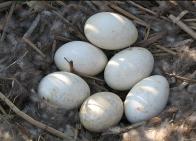
Egg addling is the term for rendering goose eggs non-viable, preventing goslings from hatching. Egg addling has a compound effect in reducing the resident Canada goose population. Not only are the year’s hatchlings reduced, but when goslings mature they tend to nest in the same area, adding their offspring to the local population. Additionally, after one to two failed nesting seasons, mother goose is apt to move her nest to a different area.
Various addling techniques exist, including nest and egg removal, replacement with dummy eggs, shaking or puncturing eggs, and egg oiling. Our addling is performed by oiling eggs, in compliance with Humane Society of the United States (HSUS) protocols.
Cost for egg addling is based on service area size and access. Please call to schedule a complimentary review of your site so we may offer a quote. If you have volunteers available to assist us we are happy organize and train them into work details to cover more ground in less time.
Steps to Egg Addling
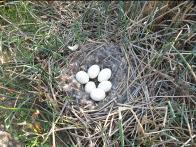
Locating Nests Geese construct nests in a variety of places, but typically they are found close to water. Islands are very desirable nesting sites. We walk and paddle the area to locate the nests, flag each site and map their locations.
While the nesting period for any particular goose is approximately one month, the nesting season is typically six to eight weeks. Three or four site visits are made within two weeks of each other to incorporate early through late nesting.
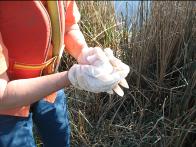
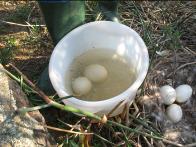
Addling When nests are located, we perform a float test on the eggs to assess embryonic development. If eggs are in the earlier stages of development they are coated with 100% food grade corn oil to prevent oxygen from reaching the embryo, rendering the eggs non-viable. If eggs are in the latter stages of development, they cannot be humanely addled. The eggs are replaced into the nest and left to develop.
Oiled eggs are also replaced into the nest so the goose continues to incubate them. If the oiled eggs are not replaced and the goose is still fertile, she may re-lay her eggs. It is no longer recommended to re-visit nests at the end of the incubation period to remove oiled eggs. This makes for one less site visit and less expense for the property owner.
Documentation For each site visit, we record the location of nests, quantity of eggs addled and plot the data on to an area map. This information is used to complete state and federal follow-up reporting requirements and for future egg addling planning.
Safety Sometimes geese are protective of their nests, but often as not they readily move to adjacent water when approached. Nonetheless, safety for us and the geese is of utmost importance. We work in teams of two for both efficiency and safety. We wear protective clothing and when accessing ponds or lakes always wear buoyancy vests.
We do not use our goose control dogs for egg addling. The dogs would only serve to keep the geese away while we are at the nests and this can be accomplished without putting such predator stress on the geese.
Regulations Two principal regulatory bodies are charged with the protection of Canada geese — the California state Department of Fish & Game and the US Fish & Wildlife Service.
The procedures to obtain a state permit and federal registration to addle resident Canada goose eggs are not burdensome, nor does either procedure cost money. The US Fish & Wildlife Service now has Internet registration. Where permitting is required in California, Fish & Game requires a letter identifying the property and anticipated number of nests.
There are 18 counties in California that do not require state permits to addle eggs. These counties include the nine San Francisco Bay Area counties, each successive coastal county between the Bay Area and San Diego, and San Benito County. Property owners in these counties can register directly with the US Fish & Wildlife Service.
For Sacramento Valley and neighboring Foothill counties a state permit is required and must be obtained before registering with the US Fish & Wildlife Service. The state permit includes a registration number that must be included with federal registration. We perform this administrative work as part of our egg addling service.